
Hair Color Levels 1-10 Chart
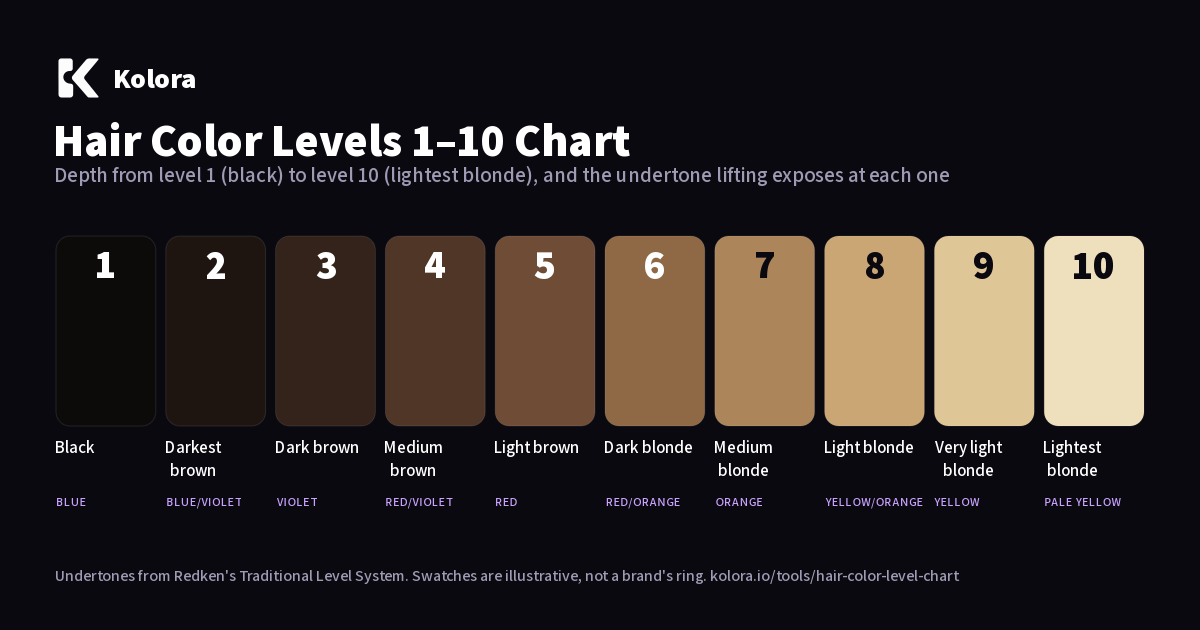
Hair color levels run 1 to 10, darkest to lightest: level 1 is black, level 10 is the lightest blonde, and level 6 is where brown becomes blonde. The level describes depth only — it carries no tone information at all. Every level also has an underlying pigment that lifting exposes, from blue at level 1 through red and orange to pale yellow at level 10, and that pigment is what decides which tone you need to cancel it.
What are the hair color levels?
Ten levels, darkest first. The scale is close to universal — it is the one part of color notation you can carry between brands without checking the chart. The last two columns are what turn it from a reference into a formulation tool: what you uncover on the way up, and what cancels it.
| Level | Depth | What it looks like | Undertone exposed | Corrective |
|---|---|---|---|---|
| 1 | Black | No visible warmth, absorbs light | Blue | — |
| 2 | Darkest brown | Reads black indoors, brown in daylight | Blue/Violet | — |
| 3 | Dark brown | Clearly brown, still very deep | Violet | — |
| 4 | Medium brown | Mid brown, warmth visible at the ends | Red/Violet | Yellow Green |
| 5 | Light brown | Light brown, red-orange underlying pigment | Red | Green |
| 6 | Dark blonde | Where brown becomes blonde | Red/Orange | Blue Green |
| 7 | Medium blonde | Orange underlying pigment on lift | Orange | Blue |
| 8 | Light blonde | Orange-yellow underlying pigment | Yellow/Orange | Blue/Violet |
| 9 | Very light blonde | Yellow underlying pigment | Yellow | Violet |
| 10 | Lightest blonde | Pale yellow underlying pigment | Pale Yellow | Violet |
The level is a target, not a starting point
A tube of 6 does not make level 6 hair. It makes level 6 if the hair is already at or below the level that product can reach with the developer you chose. Read the client’s natural level first, then decide what the tube has to do.
What are the blonde levels?
Levels 6 to 10. This is the range most lifting appointments live in, and the range where the undertone changes fastest — orange at 7, yellow-orange at 8, yellow at 9, pale yellow at 10. Getting the corrective wrong by one level is what leaves a toner looking brassy.
| Level | Depth | What it looks like | Undertone exposed | Corrective |
|---|---|---|---|---|
| 6 | Dark blonde | Where brown becomes blonde | Red/Orange | Blue Green |
| 7 | Medium blonde | Orange underlying pigment on lift | Orange | Blue |
| 8 | Light blonde | Orange-yellow underlying pigment | Yellow/Orange | Blue/Violet |
| 9 | Very light blonde | Yellow underlying pigment | Yellow | Violet |
| 10 | Lightest blonde | Pale yellow underlying pigment | Pale Yellow | Violet |
Some lines extend past 10 — Wella runs a 12 series, Schwarzkopf codes Igora Royal High Lift at 12, and L’Oréal Majirel High Lift sits outside the main range. Those are lightening products with their own developer and ratio rules, not simply “level 12 color”.
What undertone does each level expose?
Blue at level 1, blue-violet at 2, violet at 3, red-violet at 4, red at 5, red-orange at 6, orange at 7, yellow-orange at 8, yellow at 9 and pale yellow at 10. Lifting uncovers these in the same order every time, whatever the starting shade, because they are the warm pigments left behind as the cool ones go first.
The practical use is the corrective column: the tone that cancels the undertone at the level you finish on, not the one you started at. A client lifted from a 4 to a 7 has orange to deal with, not red-violet, so the toner is blue-based. Which toner, at which developer, and what to do when it fails is worked through in underlying pigment by level.
How do you read the level chart when bleaching?
Lightener has no level of its own — it is not a shade, so it is not on the scale. What the chart gives you during a bleach is the level you have reached: read the undertone column backwards. Hair that is sitting orange has stopped at level 7; yellow is level 9; pale yellow, the colour of the inside of a banana skin, is level 10. That reading decides whether the lift is finished and which toner goes on next.
How far a given developer lifts is deliberately not stated on this page. The manufacturers publish different figures for their own lighteners and do not agree with each other, so that number belongs on the instruction sheet for the product in your hand, not on a generic chart. What is fixed is the arithmetic of volume to peroxide, in the next table.
Which developer goes with which level change?
Volume and peroxide percentage are fixed arithmetic. How many levels a given strength actually lifts is not — it depends on the line, and the manufacturers do not agree with each other.
| Volume | Peroxide | What it is for |
|---|---|---|
| 10 vol | 3% | Deposit only. Tone-on-tone, glossing, going darker. |
| 20 vol | 6% | The standard for gray coverage and for lifting a small amount. |
| 30 vol | 9% | Lift. How much depends on the line — check the brand's own chart. |
| 40 vol | 12% | Maximum lift, and where most lines cap. Reserved for high-lift shades. |
Deliberately no “lifts N levels” column. Schwarzkopf documents 9% as one to two levels on Igora Royal where a generic chart would call 30 vol two to three; Wella maps Welloxon Perfect 20 vol to gray coverage or a single level. Use the ratio and developer your line publishes — those are collected in the mixing ratio calculator.
Hair color levels 1-10 by brand: how each line writes the level
The level is always the leading digit. Only the punctuation after it, and what the line does above 10, change between brands. Every example below is the same color: level 6 with an ash primary tone.
| Line | Format | Level 6 ash | Above level 10 |
|---|---|---|---|
| Wella Koleston Perfect | Level/tone tone | 6/1 | A 12 series for high-lift, with its own developer rules. |
| Schwarzkopf Igora Royal | Level-tone tone | 6-1 | Igora Royal High Lift is coded at 12. |
| L'Oréal Majirel | Level.tone tone | 6.1 | Majirel High Lift is coded separately from the main range. |
| Redken Shades EQ | Level + letters | 06T | Runs to 010, where the leading zero is part of the level — 010 is lighter than 09. |
| Matrix SoColor | Level + letters | 6A | High-lift shades carry their own UL prefix. |
| Goldwell Topchic | Level + letters | 6A | High-lift blondes are a separate N-series. |
| Alfaparf Evolution | Level.tone tone | 6.1 | High-lift shades sit in a dedicated superlightener range. |
| Revlon Revlonissimo | Level.tone tone | 6.1 | Intense Blonde shades are numbered separately. |
Frequently asked questions
What are the 10 levels of hair color?
1 black, 2 darkest brown, 3 dark brown, 4 medium brown, 5 light brown, 6 dark blonde, 7 medium blonde, 8 light blonde, 9 very light blonde, 10 lightest blonde. The scale describes depth only and carries no tone information.
Is level 1 the darkest or the lightest?
Level 1 is the darkest — black. The numbers climb as the hair gets lighter, so level 10 is the lightest blonde. This is the opposite of the way some consumer boxes number their shades, which is a common source of confusion at the consultation.
What level is dark blonde?
Level 6. It is the boundary level, where brown becomes blonde, and it exposes a red-orange undertone on lift — which is why a level 6 lift so often reads brassy without a blue-green corrective.
What undertone does each level expose?
Blue at level 1, blue-violet at 2, violet at 3, red-violet at 4, red at 5, red-orange at 6, orange at 7, yellow-orange at 8, yellow at 9 and pale yellow at 10. Lifting always uncovers these in the same order, which is why the corrective tone is decided by where you finish, not by where you started.
How do I find my client's natural level?
Take it at the root, on dry unwashed hair, in daylight rather than under salon lighting, and compare against a level ring held flat against the scalp. Mid-lengths and ends have usually been colored or lifted before and will read lighter than the true natural level.
Does the level scale mean the same thing in every brand?
The level does. A 6 is a dark blonde in every professional line, and it is the reliable part of a shade code to carry across brands. The tone digits after it are not — those are brand-specific and have to be translated through the tone name rather than digit for digit.
How we sourced this
The depth names are consistent across the major manufacturers’ own charts, and match the table published in hair color numbers explained by brand. The underlying-pigment and corrective columns are Redken’s Traditional Level System, read off the 2024 Shades EQ wall chart and checked on . They are shared with the Shades EQ chart rather than re-typed, so the two pages cannot disagree.
There is deliberately no “developer lifts N levels” claim on this page: the manufacturers publish different mappings and inventing a consensus between them would be the kind of number a colorist acts on and a client pays for. Confirm against the chart for your line. Color formulation is a chemical service performed by licensed professionals.